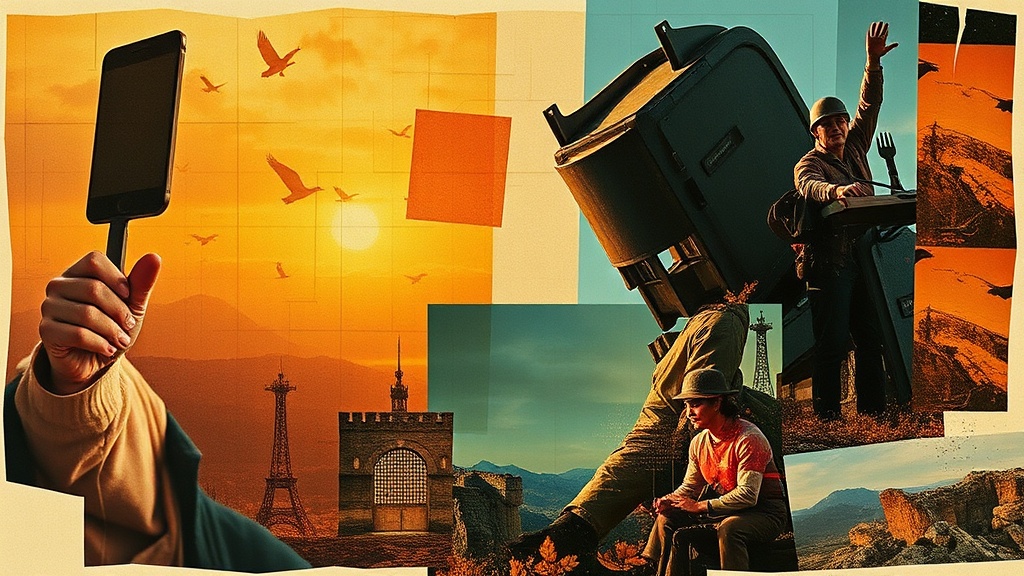
Why Collage Techniques Belong in Every Poet's Toolkit

You're staring at a blank page—again—and the words won't come. Your notebook sits open, the cursor blinks, and nothing happens. Most poets hit this wall because they're trying to pull language out of thin air, as if good lines materialize from mental effort alone. But there's another way: start with scissors, glue, and a stack of old magazines. Mixed media collage isn't just for visual artists. When you cut, arrange, and layer physical materials before you write, you bypass your internal editor and tap into something more instinctive. This guide walks through how collage techniques can transform your poetry practice—from generating unexpected imagery to discovering the emotional weight of juxtaposition.
What Is Found Poetry Collage?
Found poetry collage—sometimes called cut-up poetry or erasure—borrows from visual art traditions where artists assemble disparate fragments into cohesive wholes. The technique emerged from Dada experiments in the 1920s, gained momentum through William S. Burroughs' cut-up method in the 1950s, and continues evolving today through contemporary poets like Terrance Hayes and Tracy K. Smith.
Here's how it works in practice: you gather source material (old newspapers, junk mail, packaging, discarded books), cut out words and phrases that catch your attention, then arrange them on paper without overthinking. The constraint forces you to work with what's available rather than what you think you need. You're not generating new text—you're curating existing language into unexpected configurations.
The physical act matters. Your hands move faster than your critic can intervene. A word catches your eye because of its texture, its color, or simply its shape on the page. You place it next to another word for visual balance, then realize the combination suggests a narrative you hadn't planned. This isn't random—it's associative logic, the same mechanism that drives memorable metaphor.
How Do You Start a Collage Poem Without Overthinking?
Begin with constraints that limit your choices. Grab three magazines you wouldn't normally read—automotive repair, home gardening, fashion advertising. Set a timer for fifteen minutes and cut out any word or phrase that creates a physical response: a tightening in your chest, a half-smile, a moment of recognition you can't quite name.
Don't read for meaning yet. You're collecting sound and texture. A phrase like "premium synthetic blend" might sit next to "seasonal affective disorder"—two registers of language that would never meet in conventional writing. That's exactly the point.
Once you have a pile of fragments, sort them into rough categories: nouns, verbs, phrases, questions. Then start arranging. Work quickly. If you hesitate, move on. Your first composition won't be your final poem—it's a sketch, a prototype, a way of discovering what wants to emerge.
The cut-up method treats language as a physical material—something you can tear, rearrange, and recombine until it reveals patterns your conscious mind couldn't plan.
After you've arranged your fragments, photograph or transcribe the result. Now the real work begins: refining, connecting, finding the through-line. Some poets leave their collages raw—visible tape, torn edges, the evidence of process intact. Others use the collage as a generative exercise, then rewrite the resulting text into more conventional lineation. Both approaches are valid. Both produce different effects.
Can Visual Composition Teach Us About Line Breaks?
Visual artists understand negative space—the areas where nothing happens create meaning as much as the areas where something does. Poets often struggle with this concept. We fill lines because empty space feels like failure. But collage teaches you to read the gaps.
When you arrange cut-out words on a page, you're making decisions about proximity and distance. Two words placed close together suggest intimacy. The same words separated by white space create tension, hesitation, or time passing. You start thinking spatially about temporal effects.
This translates directly to line breaks. A line break isn't just where you run out of breath—it's a compositional choice about what information to delay, what connections to emphasize, what meanings to allow to accumulate. James Longenbach's work on poetic form explores how visual arrangement shapes reading experience, and collage offers a hands-on way to internalize these principles.
Try this: create a collage where no two words touch. Force yourself to work with isolation, with fragments that refuse to cohere. Then write a poem using only short lines—one or two words per line. Notice how the white space becomes active, how silence starts participating in meaning.
What Happens When You Layer Different Source Materials?
Single-source collage produces one kind of poem—coherent in vocabulary, limited in register. But when you combine materials from different contexts, you create friction. A medical textbook collided with a children's story produces different effects than either source alone.
This layering mirrors how we actually experience language. We don't live in single-register environments. We scroll through social media, overhear conversations on buses, read billboards and prescription warnings and text messages—all within the same hour. Our internal monologues are already collages. The technique simply makes this visible.
Consider the work of Aimee Nezhukumatathil, whose poems often weave scientific terminology with personal narrative, or Claudia Rankine's Citizen, which incorporates visual art, scripts, and quoted dialogue. These poets understand that authentic contemporary voice often requires strategic borrowing, collage-like accumulation of disparate materials.
Your source choices also carry political weight. Cutting up advertising copy repurposes commercial language for personal expression. Erasing text from canonical works—what poets call "white-out" or blackout poetry—can critique power structures embedded in language itself. The materials you choose frame what you're trying to say before you arrange a single word.
Practical Exercise: The Three-Source Method
Try this structured approach for your first serious collage poem:
- Source A: Something personal—a letter, journal entry, text message thread
- Source B: Something institutional—instructions, regulations, terms of service
- Source C: Something organic—seed catalogs, field guides, weather reports
Cut at least ten fragments from each source. Mix them together, then arrange without looking at your original texts. The collision of registers will produce juxtapositions you couldn't invent intentionally. Personal revelation meets bureaucratic language; institutional authority gets interrupted by organic cycles.
How Can You Translate Collage Into Finished Work?
The physical collage is a means, not necessarily an end. Some poets publish their actual collages—torn edges, glue stains, and all—as final artifacts. Others use the collage process to generate raw material, then type up the resulting text and revise it into more conventional forms.
Both approaches have advantages. Published collages preserve the evidence of process. Readers see the seams, understand that the language was assembled rather than summoned. This can create productive distrust—audiences question authorship, intention, meaning in ways that pure text sometimes doesn't provoke.
Translated collage—turning your physical arrangement into typed lines—allows for refinement. You can smooth transitions, adjust rhythm, add connective tissue. But be careful not to over-edit. The power of collage comes from its discontinuities, its refusals to fully explain. If you translate your fragments into seamless narrative, you might lose what made the technique valuable.
A middle path: photograph your collage, then write from the image. Keep the photograph visible as you draft. Let the visual relationships—what's above what, what's partially obscured, what's falling off the edge—inform your line breaks and stanza breaks. The physical memory of arrangement becomes a compositional guide.
Experiment with preservation. Some poets scan their collages at high resolution, then project them behind their readings. Others incorporate collage elements into handmade books or broadsides. The materiality of the process can extend into the materiality of publication—each copy slightly different, each containing the evidence of its making.
There's no wrong way to finish. What matters is that you've interrupted your usual patterns, forced yourself to work with found rather than invented language, discovered connections through physical manipulation rather than mental planning. The collage taught you something. Don't lose that teaching in translation.