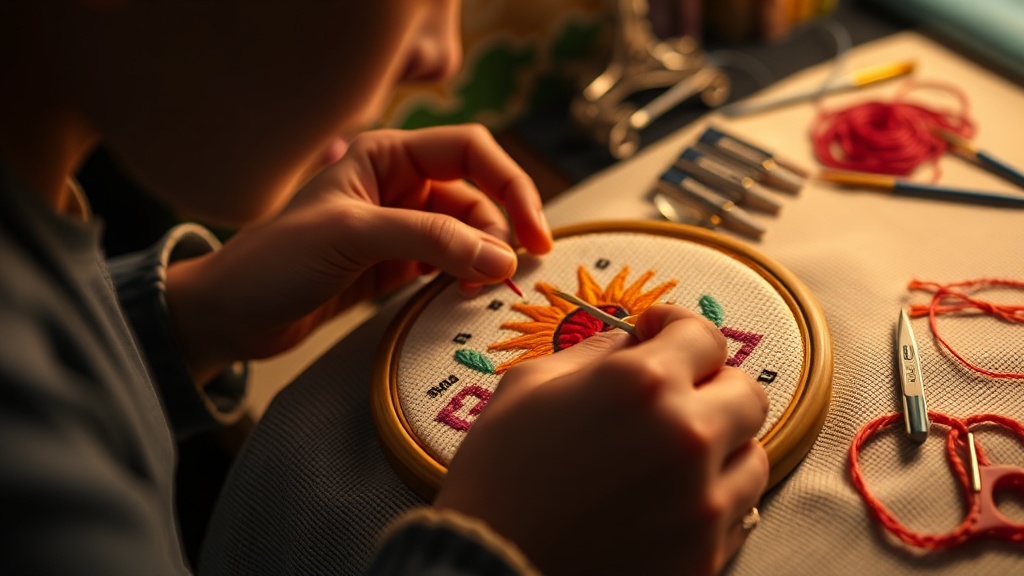
What Can Cross-Stitching Teach You About Crafting Tight, Precise Lines?

Why Do Poets Keep Returning to Fiber Arts for Inspiration?
Here's something that might surprise you: the Craft Council's 2023 survey found that 67% of writers who regularly practice a secondary art form report faster revision times and sharper editing instincts. The connection isn't coincidental. When you work with your hands in a medium that demands precision, those habits migrate into your writing practice. Cross-stitching, embroidery, and needlework share a curious DNA with poetry—both require counting, spacing, and building complex images from simple, repeated elements. This post explores what fiber artists have figured out about restraint and precision, and how those lessons translate into leaner, more impactful verse.
You don't need to pick up a needle to benefit from this. The principles that guide a well-stitched sampler—consistency, intentional gaps, and the patience to undo what's not working—mirror the habits of poets who write lines that land with weight and clarity. Let's look at seven specific techniques from the world of cross-stitching that can reshape how you approach your next draft.
How Can Counting Stitches Improve Your Line Breaks?
Cross-stitch operates on a grid. Every X sits in its designated square, and the pattern emerges through systematic placement. Miss a count, and the whole image skews. Poets face a similar grid—not of fabric squares, but of breath units and rhythmic expectations.
When you break a line in poetry, you're deciding where the reader pauses, where the thought carries over, where the tension lives. Fiber artists count threads because the medium demands it. Writers can borrow this discipline by counting stresses, syllables, or simply the visual weight of a line before committing to the break. Try this: take a poem draft and relineate it three different ways. Count the beats in each version. Notice how the meaning shifts when the pause moves two syllables earlier or later. That's your grid speaking.
The constraint forces creativity. A cross-stitcher can't fudge a missing stitch; they must backtrack or adapt the pattern. In poetry, the constraint of form—or self-imposed rules about line length—creates pressure that often produces unexpected solutions. Your line breaks aren't arbitrary decorations. They're structural decisions that hold the poem's architecture together.
Why Should Every Poem Have a "Wrong Side"?
Flip over a piece of embroidery, and you'll see the chaos—the knots, the carried threads, the evidence of decisions made and reversed. The front presents a clean face. The back tells the story of process. Poems have this too, though we rarely acknowledge it.
The draft history of a poem—the false starts, the abandoned stanzas, the lines that circled around an image without landing—deserves recognition. The Poetry Foundation's archive holds draft after draft of famous poems, and the evolution rarely follows a straight line. Elizabeth Bishop's "One Art" went through seventeen documented drafts. The finished poem looks inevitable. The backside reveals the struggle.
Give yourself permission to have a messy wrong side. Don't delete your draft documents. Keep the versions that didn't work. They're evidence of your process, and sometimes—months later—a discarded thread turns out to be exactly what a new poem needs. The visible poem is the front of your fabric. The work that got you there is the back. Both matter.
How Do Negative Spaces Shape What We See?
In cross-stitch, the unstitched fabric matters as much as the stitched areas. The background isn't empty—it's active negative space that defines the subject's edges. A bird stitched in blue thread against white linen isn't just the blue thread. It's the shape the white space makes around it.
Poets often overwrite, filling every corner with image and explanation. The result can feel crowded, airless. What happens when you leave more linen showing? When you trust the white space to carry part of the meaning? Consider William Carlos Williams's "The Red Wheelbarrow." The poem is mostly gaps—line breaks that create caverns of silence around each image. The wheelbarrow doesn't sit in a dense description. It floats in the white space, and that space amplifies its presence.
Try writing a poem where you alternate lines of image with lines of deliberate absence—not silence exactly, but simple statements that create room. "It is raining." "The window is open." These lines don't advance a narrative. They create space around whatever comes next. Your reader needs somewhere to stand. Give them the unstitched background.
What Happens When You Limit Your Thread Palette?
Cross-stitch patterns typically work with a restricted set of colors—sometimes as few as three or four threads. The limitation isn't a handicap. It's a design choice that forces the artist to rely on contrast, proximity, and pattern rather than chromatic variety. The result often feels more cohesive than work done with every color available.
Poets face the same choice with vocabulary. The thesaurus is infinite, but infinite choice often produces muddy results. Try limiting your lexical palette for a single poem. Choose five words that must appear. Exclude all forms of "is" and "was." Ban adverbs. These constraints sound arbitrary because they are—but so is a thread count of 14 per inch. The constraint creates a framework for decision-making.
The Oulipo movement built entire poetics around artificial constraints—lipograms that exclude certain letters, snowball stanzas that grow word by word. You don't need to join a movement. Just pick a limitation for one draft. Notice how quickly the constraint forces you into new territory. When you can't reach for your usual vocabulary, you discover phrases you wouldn't have found otherwise.
How Does Frogging Your Work Make You a Better Writer?
"Frogging" is cross-stitch slang for ripping out stitches—pull the thread, and rip it, rip it, rip it. Nobody enjoys it. The time invested vanishes. But the fabric remains, ready for new work, and the stitcher carries forward the knowledge of what didn't fit.
Poets need to frog more often. We get attached to our clever lines, our striking images, our well-crafted metaphors. We force them into poems where they don't belong because we paid for them in effort. This is the sunk-cost fallacy wearing literary clothing. The line that doesn't serve the poem—no matter how beautifully written—needs to go.
Start a document called "The Frog Pond." Every time you cut a line from a draft, paste it there. The line isn't gone; it's just not in this poem. You'll build a collection of orphaned phrases that sometimes find new homes months later. More importantly, you'll build the habit of evaluating your work honestly. Does this line earn its place? Does it advance the poem's purpose? If not, reach for your seam ripper.
Why Does Repetition Create Rhythm Rather Than Boredom?
Cross-stitch is repetition made visible. Thousands of identical X's, row after row, create complex images through variation and placement. The individual stitch is simple. The accumulated pattern is intricate. This principle—simple elements, complex arrangement—underlies much of the best poetry.
Anaphora (repeated opening words), refrains, and parallel structure create rhythm through predictability. The reader learns the pattern, anticipates the variation, experiences satisfaction when the expectation is met or cleverly subverted. Gwendolyn Brooks's "We Real Cool" repeats "We" at the end of each line rather than the beginning—breaking the pattern while maintaining it. The tension between expectation and delivery generates energy.
Don't fear repetition in your drafts. Fear aimless variation. If your vocabulary shifts constantly without pattern, the reader has nothing to hold onto. Try writing a stanza where every line begins with the same word. Then write one where every line ends with the same word. Then break those patterns in the final stanza. You're teaching your reader how to read your poem—and then surprising them once they've learned.
How Can You Tell When a Piece Is Actually Finished?
Cross-stitchers talk about "overworking" a piece—adding one more color, one more backstitched outline, one more French knot until the fabric feels crowded. The original clarity gets lost in embellishment. Knowing when to stop is its own skill, separate from knowing how to execute.
Poets overwork drafts too. We read them again and again, finding something new to tweak each time—the synonym that's slightly more precise, the line break that shifts meaning marginally, the title that captures something else. At some point, the draft stops improving and starts merely changing. The energy flattens. The poem becomes overworked fabric.
Set a limit. Three drafts, or five, or ten—whatever number makes sense for your process. When you hit it, stop. Send the poem out. Start the next one. The cross-stitcher frames the finished piece and begins a new pattern. They don't keep adding stitches to the old one. Your next poem will benefit more from your attention than your current draft will benefit from one more revision.
The connection between fiber arts and poetry isn't metaphorical fluff. It's a practical, transferable discipline of attention. Count your stitches. Leave some linen showing. Know when to frog. The habits you build with your hands will follow you to the page—precise, patient, and ready for the next row.