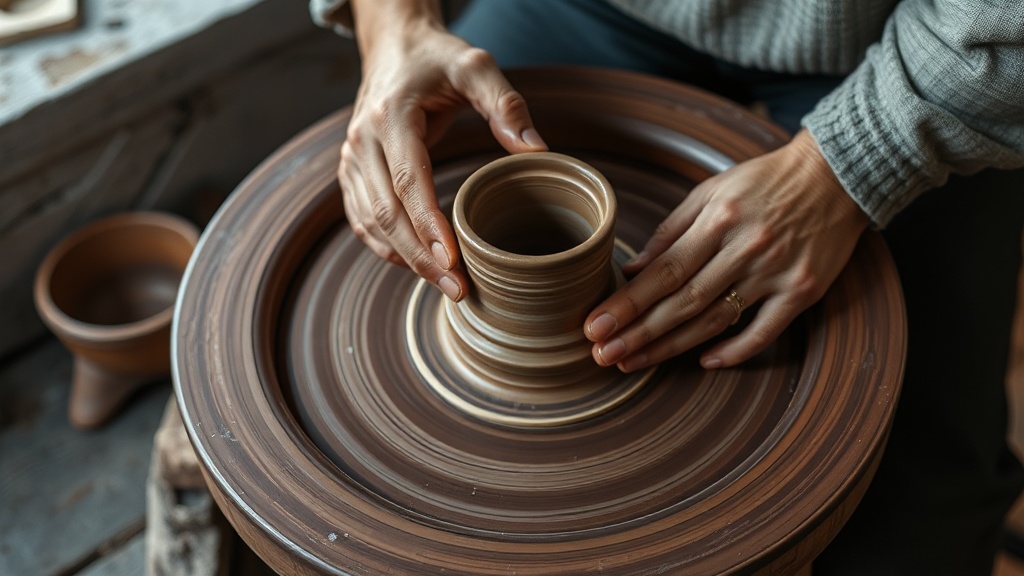
What Can a Potter's Wheel Teach You About Revising a Poem?

Have you ever written a poem that felt right in the moment but fell apart the next morning? Every poet knows the disappointment of a draft that promised more than it delivered. The images were vivid, the metaphor seemed sharp—but something didn't hold. You might blame inspiration (or the lack of it), but the real issue is usually structural. The poem didn't have a center. It wobbled. And here's where an unlikely teacher can help: the potter's wheel. For centuries, ceramicists have understood that a vessel can't take shape until the clay is centered. Poets would do well to borrow that patience—and maybe a little clay under their fingernails too.
Both crafts begin with resistance. Clay resists the hand; the blank page resists the first word. The potter learns to work with that resistance rather than against it, using water and pressure to coax the material into compliance. Poets often fight their material—forcing a rhyme, jamming a metaphor where it doesn't fit, insisting on a form the content rejects. The wheel teaches surrender. You can't bully clay into beauty, and you can't bully a poem either.
How Does the Potter's Centering Practice Apply to Finding a Poem's Focus?
Before a potter pulls up the walls of a bowl or opens the base of a vase, they spend long minutes centering the clay—pressing it into perfect alignment with the spinning wheel. Rush this step and the piece will wobble, collapse, or crack in the kiln. It's boring to watch. It looks like nothing is happening. But everything depends on it.
Poems need centering too. Not a theme stated bluntly in the first line (no one needs another poem that begins by announcing its subject), but a gravitational pull that keeps every image, every break, every sound pointed in the same direction. When you draft, ask yourself: what's the weight at the heart of this? It might be a question you can't answer. It might be a single image that arrived before you understood why. Centering means identifying that weight and letting the rest orbit it.
Many poems fail because they try to do too much. The poet has three good ideas and crams them into sixteen lines. The result isn't richness—it's drift. A potter doesn't throw a bowl, a mug, and a plate from the same lump of clay. You shouldn't try to make a poem about grief, spring, and your grandmother's hands all compete for attention. Pick the clay up. Center it. Then see what form it wants to take. Sometimes the poem wants to be a small cup, not a towering vase. Your job is to find out before you start pulling walls that have nowhere to go.
Why Do Poets Rush the First Draft When Clay Teaches Us to Go Slow?
There's a peculiar anxiety that sets in when the blank page stares back. You want to fill it. You want the relief of completion. So you write fast, chasing the heat of the initial idea, and you call the draft finished before it's even found its shape. Potters call this "chasing the wheel"—moving your hands faster than the clay is ready to go. The result is usually a lopsided mess that has to be wedged back into a ball and started over.
Slowing down doesn't mean writing fewer poems. It means giving each draft the time it needs at each stage. The first pass is for throwing—getting the material down without judgment. The second pass is for shaping—seeing where the walls are too thin, where the base needs opening. The third pass (and fourth, and fifth) is for the details: the lip of the bowl, the foot, the surface texture. Each stage has its own rhythm, and you can't skip ahead without paying for it later.
The Poetry Foundation publishes thousands of poems that look effortless on the page, but read the interviews and you'll find poets who draft for months. Some rewrite single lines dozens of times before they surrender. That slowness isn't preciousness—it's structural necessity. A poem, like a pot, has to hold something. If the walls are rushed, it leaks. If the base is too thin, it cracks under the weight of what you're asking it to carry.
What Happens When You Treat Revision Like Trimming a Wet Vessel?
In pottery, there's a stage called "leather-hard"—the clay is dry enough to handle but still soft enough to cut, carve, and refine. Miss this window and you're stuck with whatever shape you have. Poems have a leather-hard stage too. It's that period after the first draft when the language is still alive, still malleable, but beginning to set. This is where the real craft happens. Wait too long and the poem becomes brittle; approach too early and you distort what you've made.
Trimming a wet vessel means removing what doesn't serve the form. You cut away clay to create a foot ring so the pot can stand on its own. You carve away excess weight so the walls don't sag under their own thickness. In poetry, this means cutting the line that sounds beautiful but doesn't earn its place. It means removing the adjective that explains what the image should already show. It means asking, brutally, whether that stanza moves the reader closer to the center—or just shows off your vocabulary.
This is the hardest part because we fall in love with our own language. That metaphor about the rain sounding like typewriter keys? It's clever. But if it pulls the reader away from the emotional core, it has to go. The same goes for the stanza that took you three hours to write. If it doesn't serve the whole, it's just a pretty lump of clay. The Academy of American Poets offers countless craft essays that treat revision as continuation rather than correction. The poem isn't broken; it's just not finished growing. Every cut is a choice about what matters more.
There's another pottery concept worth stealing: the "bisque firing." This is the first trip through the kiln—a low-temperature bake that hardens the clay enough to accept glaze. Think of it as putting the poem away for two weeks. When you return, you see it with stranger eyes. The lines you thought were necessary reveal themselves as habits. The weak transitions glare. The center—if you found it—holds, or it doesn't. And if it doesn't, no amount of glazing will save it.
After bisque comes glazing: the deliberate choice of surface, color, finish. In poetry, this is sonic texture, lineation, the white space around the stanzas. A potter chooses matte or gloss, drip or precision. You choose long lines that spill like water or short lines that stab like broken clay. These aren't decorative afterthoughts. They're integral to how the piece functions—how it meets the hand, how it meets the eye. Ceramic Arts Network documents how master potters often make the same form hundreds of times before achieving the one that matters. Poets should take comfort in this. Your fifteenth draft isn't failure—it's the natural accumulation of attention. The poem that lasts is the one you've touched at every stage, from the wet lump to the fired vessel.
When you sit down to your next draft, remember the wheel. It spins whether you're ready or not. The clay doesn't care about your deadlines. Center it. Slow down. Cut away what wobbles. Let it fire. The poem you make might just hold something worth keeping.