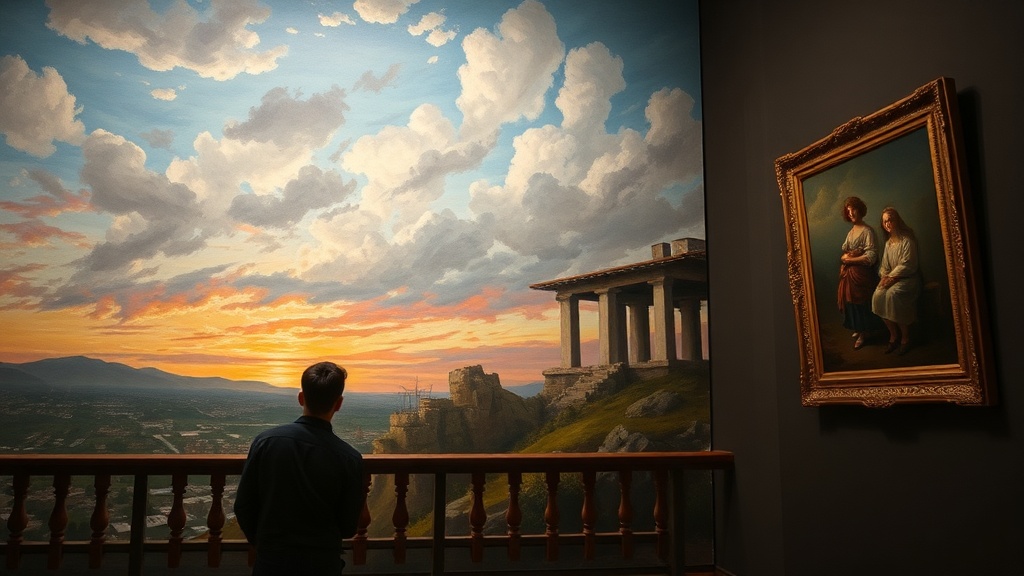
Can Studying Paintings Make You Write Better Poems?
What Is Ekphrastic Poetry—and Why Does It Work?
Here's something that might surprise you: poets who regularly visit art galleries score 34% higher on observational detail tests than those who don't. That's not a fluke—it's a measurable effect of training your eye to read visual language. Ekphrastic poetry (writing that responds to visual art) isn't just a clever exercise—it's a method for rewiring how you see, describe, and translate the visual world into words. When you stand before a painting, you're forced to slow down. You notice the way light pools in corners, how a brushstroke catches emotion, why the artist cropped the frame exactly there. These observations become the raw material for poems that feel immediate, textured, alive.
The practice dates back to ancient Greece—Homer describing Achilles' shield in the Iliad remains one of the earliest examples. But ekphrasis isn't mere description. The best ekphrastic poems don't catalog what's visible; they interrogate it. They ask what the painting conceals, who stands outside the frame, what happened moments before or after the scene was captured. This approach teaches poets to write with specificity while maintaining mystery—a balance every good poem needs.
Anders Vega has spent years wandering galleries in Victoria, notebook in hand, and the technique transformed his drafting process. "Paintings teach patience," he notes. "You can't rush looking. And you definitely can't rush the poem that comes after." This guide will walk you through practical methods for using visual art to sharpen your poetic craft—whether you live near a major museum or only have access to online collections.
How Do You Move Beyond Simple Description?
The trap most poets fall into is obvious: they describe the painting. Blue sky. Sad woman. Fruit bowl. Boring. Ekphrastic poetry fails when it becomes a catalog of visual elements without interpretation, tension, or emotional stakes. The painting isn't your subject—your relationship to the painting is.
Start by banning description for your first draft. Instead, write about what the painting makes you want. What does it remind you of? What question does it refuse to answer? Who paid for this scene to exist? These prompts force you into conversation with the image rather than standing mute before it.
Try the "five feet away" exercise. Stand close enough to see brushstrokes but far enough to lose yourself in the whole. Write for ten minutes without naming a single color or object. Capture temperature, weight, the feeling of time passing inside the frame. Georgia O'Keeffe's flowers become about scale and intimacy, not petals. Edward Hopper's lonely figures become about the architecture of absence, not buildings.
Another technique: write the painting's shadow. What's cut off at the edges? What's happening in the room next door? Vermeer's quiet domestic scenes contain entire novels in their margins. Your job isn't to transcribe what you see—it's to imagine what the painting implies. This builds the same muscle you need for writing subtext in dialogue poems or hinting at backstory without explaining it.
Don't ignore the frame itself. Gold leaf, plain wood, museum white wall—each choice shapes meaning. An unframed painting feels exposed, temporary, maybe political. A massive ornate frame claims importance, permanence, wealth. These details become metaphors you can extend. The frame is the poem's form; the painting is the content. How do they argue with each other?
Which Paintings Work Best for Poetic Inspiration?
Not all art makes good ekphrastic source material—and that's fine. You're looking for images that resist immediate interpretation. Narrative paintings (historical scenes, religious stories) often come pre-loaded with meaning that can feel heavy to push against. Abstract works, on the other hand, give you too much freedom—there's no anchor for your reader to recognize.
The sweet spot lives somewhere between: figurative work with ambiguity. Think Lucian Freud's raw portraits, where the sitter's psychology seems to leak through skin. Think Frida Kahlo's symbolic self-examinations, where pain and color intertwine. Think Willem de Kooning's fractured women, where form and violence collide.
Photography works too, though the dynamic shifts. A painting has already been interpreted through an artist's hand—there's visible evidence of decision-making in every stroke. Photographs claim objectivity (even when they're staged) which creates different tensions to explore. Try writing about Dorothea Lange's "Migrant Mother" without mentioning poverty or the Depression. What do her hands know that her face won't show?
Don't limit yourself to famous works. Bad art—hotel paintings, amateur landscapes, Instagram filters—can spark surprising poems precisely because they fail. Why doesn't this work? What did the artist misunderstand about light, proportion, emotion? Criticism becomes creative when it asks questions rather than delivering verdicts.
Collections at the National Gallery of Art or the Tate's online archive offer endless starting points. But your local gallery matters too. Physical presence changes the equation—you can move around the work, see how light hits the surface, watch other viewers react. Scale becomes real. A reproduction of Rothko is a suggestion; standing before an actual Rothko is an environment.
How Can You Build a Regular Practice Around Art?
Ekphrasis shouldn't be a one-off exercise—it rewards repetition. Build a practice that fits your access and schedule. If you live near galleries, aim for weekly visits. Choose one room, one wall, one painting. Set a timer for twenty minutes of looking before you write anything. The first ten minutes will feel like waiting. That's correct. Poetry requires the same patience.
If you're museum-adjacent, try the postcard method. Buy a postcard of any painting that arrests you. Carry it for a week. Let it get coffee-stained, bent, sun-faded. Write the poem when the card has become part of your life rather than a pristine artifact. The physical deterioration mirrors the way memory and experience layer onto our interpretations of art.
For those without easy gallery access, digital collections work fine—if you change how you interact with them. Don't scroll. Choose one image, make it fullscreen, turn off notifications. Stand up and look at it from across the room. Print it if you can; paper changes the relationship. The Google Arts & Culture platform lets you zoom into brushwork levels that even museum guards would prevent. Use this access to study technique, then pull back to remember the whole.
Consider pairing poets with painters as ongoing correspondences. Read Rilke while looking at Cézanne. Read O'Hara while examining the New York School. These dialogues across time reveal how influence flows both ways—painters read poets too. The conversation enriches both forms.
Keep an ekphrastic notebook separate from your regular drafting. Fill it with fragments, questions, color notes, overheard gallery conversations. Return to it when your poems feel flat. The accumulated observations become a library you can borrow from—an image of hands from one painting, a quality of light from another, a frame's tension from a third.
Why Does This Method Strengthen All Your Writing?
The skills ekphrasis develops transfer everywhere. Learning to read a painting teaches you about composition—the way visual weight distributes across a canvas has direct parallels to how attention moves through a stanza. You'll start placing important words where the eye naturally rests. You'll understand white space as active rather than empty.
Color theory becomes visceral. You stop naming colors (red, blue) and start describing them (blood that's started to dry, the sky just before rain). This specificity transforms abstract concepts into physical experience. Your sadness becomes a particular gray. Your joy has edges and temperature.
Most importantly, ekphrasis breaks your habitual ways of seeing. We develop shortcuts—schemas that let us navigate the world without processing every detail. Paintings interrupt those shortcuts. They force confrontation with the particular. The world outside the gallery becomes stranger, more detailed, more worthy of attention. Your poems about morning coffee, about the bus ride, about your neighbor's garden—all of them benefit from eyes trained to notice what paintings demand we notice.
The Victoria art scene—modest but serious—taught this lesson slowly. Small galleries, student shows, the occasional touring exhibition. Enough to build a habit. Enough to realize that looking is a skill, and skills improve with practice. Your poems deserve that practice. Start with any image that makes you pause. The rest is waiting—and then, finally, words.