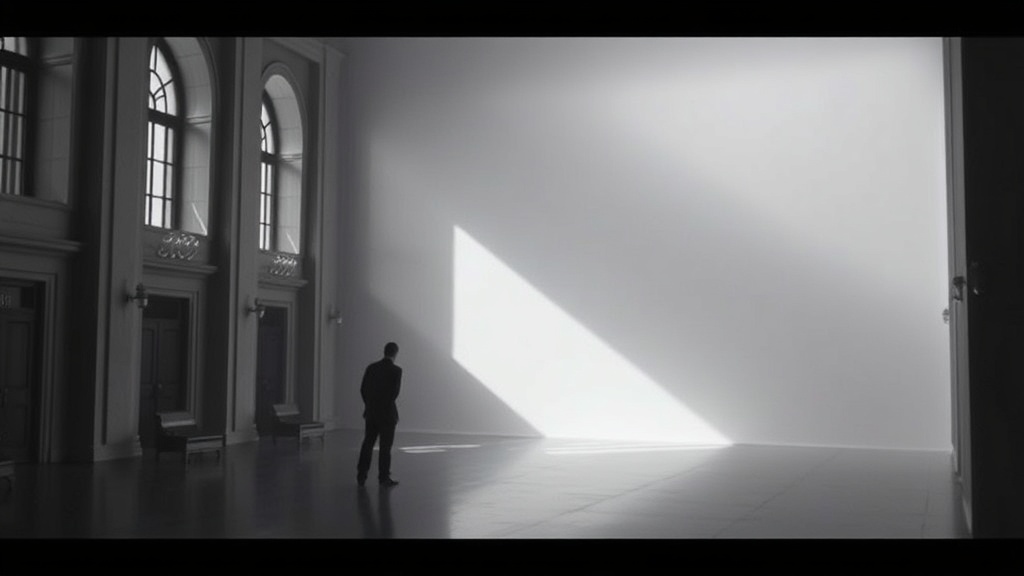
Building Poetic Tension with White Space

A poem that looks like a dense block of text often feels heavy, even if the words themselves are light. When you look at a page of verse, your eyes don't just read the letters; they read the gaps between them. This post covers how to use white space—the literal empty area on your page—to create tension, control pacing, and direct the reader's breath. Mastering this technique turns a simple sequence of lines into a rhythmic experience.
White space isn't just "empty." It is a deliberate tool. If you leave a wide gap between two stanzas, you're forcing the reader to pause. You're making them sit in the silence. That silence is where the emotional weight lives.
How Do You Use White Space to Create Tension?
You create tension by disrupting the expected rhythm of a poem through intentional line breaks, stanzaic gaps, and irregular spacing. When a reader expects a steady beat and you suddenly drop a single word onto a line by itself, the tension spikes. The eye pauses. The brain waits for the resolution that doesn't come immediately.
Think about the difference between these two structures:
Option A (Low Tension):
The river runs cold and deep,
Under the willow where shadows sleep,
The moon is a silver light,
Guiding us through the night.
Option B (High Tension):
The river runs
cold
and
deep.
Under the willow,
shadows sleep.
Option A is a standard quatrain. It's comfortable. Option B uses verticality to slow the reader down. By isolating "cold" and "deep," you force the reader to feel the weight of those words. The white space acts like a physical barrier. It's a way to make the reader work a little harder—and that effort creates a sense of unease or anticipation.
You can also use "caesura"—a break within a line—to create micro-moments of tension. A dash (—) or a period in the middle of a line creates a sudden halt. It's a jagged edge in an otherwise smooth sentence. This is a technique often used in modern poetry to mimic the way human thought actually works (it's rarely a straight line, after all).
What Is the Difference Between Line Breaks and Stanza Breaks?
Line breaks control the internal rhythm of a thought, while stanza breaks control the structural shifts in a poem's movement. A line break is a momentary breath; a stanza break is a full stop.
When you break a line, you're managing the "enjambment"—the way a sentence spills over from one line to the next. If you end a line on a verb, the reader feels a pull to move to the next line. If you end on a noun, the line feels finished and heavy. This is a subtle way to manipulate how fast a person moves through your work.
Stanza breaks, on the other hand, are much larger gestures. A wide gap between stanzas can act like a change in scene or a shift in time. It's the poetic equivalent of a "cut to black" in a film. If you want to signal that a poem has moved from a physical description to an internal realization, use a stanza break. It gives the reader a moment to digest the first part before you hit them with the second.
For more on how to refine your specific style, you might look into finding your voice through sensory constraints, as the way you use space often dictates how much "sensory" weight your words carry.
Here is a quick guide to how different types of space affect the reader:
| Type of Space | Visual Effect | Emotional Result |
|---|---|---|
| Short Lines | Lots of vertical white space | Urgency, fragmentation, or breathlessness |
| Long Lines | Dense, horizontal text | Stability, exhaustion, or a sense of flow |
| Wide Stanza Gaps | Large horizontal voids | Isolation, transition, or profound silence |
| Indented Lines | Asymmetrical margins | Disorientation or a "sideways" thought |
How Much White Space is Too Much?
Too much white space becomes a distraction that breaks the reader's immersion, making the poem feel disjointed or unearned. If every single word is on its own line, the "tension" becomes a gimmick. The reader stops feeling the weight of the words and starts feeling the absurdity of the layout.
The key is intentionality. If you're using a tool like Adobe InDesign or even a basic word processor, you need to see the page as a canvas. If you're writing a poem about a frantic, crowded city, a massive amount of white space might feel dishonest. But if you're writing about a lonely desert, that space is your best friend.
A good rule of thumb is to check your "density ratio." Look at your poem. Is the white space working to highlight certain words, or is it just making the poem look sparse? If you can remove the gaps and the poem's meaning doesn't change at all, you probably haven't used the space effectively. The space should be doing work. It should be a character in the poem.
Here are three ways to test if your use of space is effective:
- The Breath Test: Read the poem aloud. Does the white space actually force you to take a breath where you intended? If you find yourself rushing through a gap, the gap isn't wide enough (or your line breaks are too weak).
- The Squint Test: Squint your eyes until the words become blurry. Look only at the shapes of the black ink and the white voids. Does the "shape" of the poem feel like it matches the mood? A jagged, broken shape feels different than a smooth, blocky one.
- The "Word-Only" Test: Read the poem without looking at the layout. If the poem loses its impact when the formatting is stripped away, your use of white space is a structural necessity, not just decoration.
Sometimes, the most powerful thing you can do is leave a word hanging. A single word at the end of a long poem, separated by three lines of empty space, can haunt a reader for much longer than a well-placed adjective. It's about the silence that follows the sound. You've spent the whole poem building a certain momentum—don't be afraid to kill it suddenly. The sudden stop is where the meaning often hides.
When you're editing, don't just look at your vocabulary. Look at your margins. Look at the "nothingness" on the page. That's where the real poetry happens.
Steps
- 1
Identify the Breath
- 2
Experiment with Enjambment
- 3
Map the Visual Silence